
The Basics: Sound & Grip
Before you can play melodies, you must master the two foundational pillars of the bansuri: producing a clear, resonant tone (the embouchure) and holding the instrument without tension (the grip).
1. Master the Embouchure (Producing Sound)
The embouchure refers to the exact positioning of your lips, jaw, and tongue in relation to the flute's blowing hole (mukha-randhra). Because the Bansuri is a simple bamboo tube with no mechanical reed or whistle, your lips act as the instrument's reed.
The Physics of the Sound
To create a clean note on a Bansuri, you must split a thin, focused stream of air right against the sharp, outer edge of the blowing hole. Half the air goes inside the flute (resonating the tube), and half goes over it.
Video Demonstration: How to position your lips and blow to produce a clean Bansuri sound. Click video to play or pause.
Step-by-Step Technique:
The Lip Placement
Do not center the blowing hole directly on your lips. Instead, place the inner edge of the blowing hole right at the border where your lower lip meets your chin skin.
The Pucker
Keep your lips relaxed but formed into a tiny, focused "O" shape, as if you are blowing out a candle through a thin straw. Avoid pulling your lips back into a tight smile, as this thins out the tone and makes the sound airy.
The Roll
Look in a mirror. Cover the blowing hole entirely with your lower lip, and then slowly roll the flute outward (away from you) by about 30 to 45 degrees while blowing a steady, gentle stream of air.
Finding the "Sweet Spot"
As you roll the flute, you will suddenly hear the airy hiss transform into a resonant, warm, and clear bamboo tone. Stop rolling right there. That is your unique embouchure sweet spot.
Diagnostic Tone Guide: How to Identify & Fix Common Sound Failures
When first blowing into the bansuri, every student experiences one of four specific tone failures. Use this diagnostic matrix to identify what you hear and apply the exact physical correction:
Observation: You hear rushing air like wind through a tunnel, but zero musical pitch.
Cause: The airstream is overshooting the opposite wall or the blowing hole is covered too little.
Correction: Place the inner edge of the hole firmly against the lower lip margin. Slowly roll inward 5 degrees, narrow the lip aperture, and blow gently downward at a 45-degree angle.
Observation: The flute screeches in the upper octave instead of producing a warm, low fundamental tone.
Cause: Air velocity is too high or lip aperture is pinched tight like a whistle.
Correction: Drop jaw slightly, relax the lip corners, and whisper the syllable “Dhooo”. Halve your blowing force—the bansuri requires air speed control, not brute air volume.
Observation: You run out of breath after only 2 to 3 seconds and feel lightheaded.
Cause: The mouth opening is too wide, dumping your lung reserve without focusing into the hole.
Correction: Form an aperture the diameter of a coffee stirrer straw in the middle of your lips. A focused micro-stream will sustain a note for 10–15 seconds easily.
Observation: The note starts in tune, then sags flat and wavers as you exhale.
Cause: Collapsing the ribcage rather than supporting breath from the lower diaphragm.
Correction: Inhale by expanding your lower abdomen; keep shoulders still. Maintain slight abdominal engagement through the entire note to keep air speed steady.
2. Adopt the Correct Grip and Posture
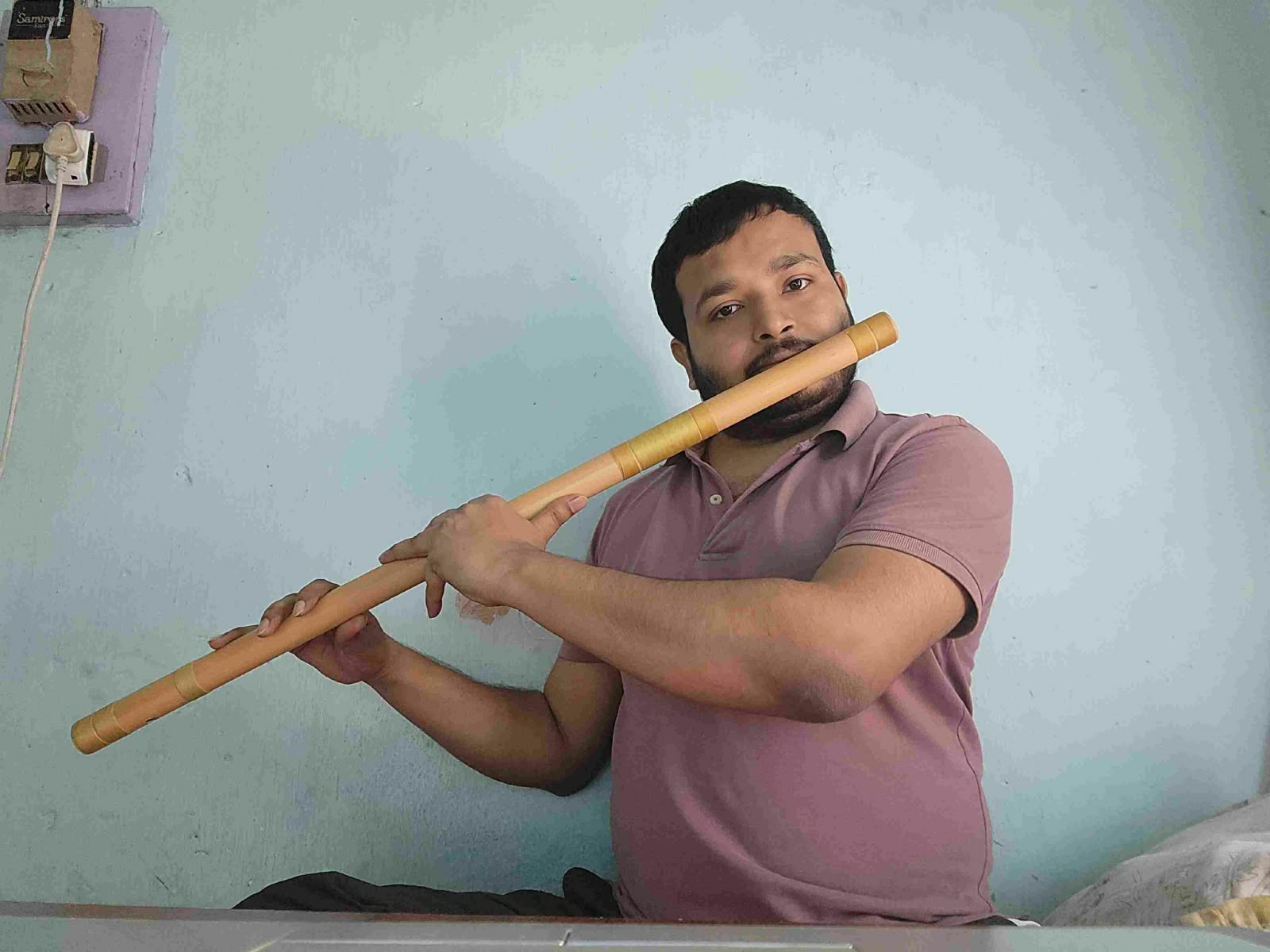
Demonstration of the correct posture, finger placement using finger pads, and flute holding angle for playing Bansuri.
In the Indian classical tradition, your posture (Aasana) dictates your breath capacity, and your grip dictates your speed and fluid ornamentation (Meend and Gamaka).
The Posture (Sitting down vs. Standing)
- Traditional Sitting:Ideally, sit cross-legged on the floor (Sukhasana or Padmasana). Keep your spine straight but entirely relaxed. A straight spine ensures your diaphragm can expand fully, providing sustained air support for long notes (Swar Sadhana).
- The Angle:Hold the flute at a downward angle of roughly 15 to 30 degrees relative to the floor. Do not hold it perfectly horizontal (which strains the shoulders) or drop it too low (which compresses the throat).
- Head Position:Keep your head straight. Bring the flute to your lips; do not tilt your head down to meet the flute.
The Grip (Hindustani Traditional Style)
Unlike a western silver flute where you use the tips of your fingers, the long Hindustani bamboo Bansuri requires a unique approach because the holes are spaced widely apart.
The Pads, Not the Tips: Always use the flat, fleshy pads of your fingers (the middle phalanx or the soft pad just below the tip) to cover the holes. Never use the very tips of your fingers. Using the pads ensures an airtight seal without needing to press down hard.
The Left Hand (Upper Hand)
- The index, middle, and ring fingers cover the top three holes.
- The left thumb acts as a crucial support anchor underneath the flute, balancing it against your lips.
The Right Hand (Lower Hand)
- The index, middle, and ring fingers cover the bottom three holes.
- Crucial Detail: The pinky finger of your right hand rests lightly on the body of the flute past the last hole to act as a stabilizer.
By practicing your embouchure for 10–15 minutes daily alongside maintaining a completely tension-free grip, your muscle memory will lock these coordinates in within a couple of weeks.

About the Author
Written and practice-tested by Aplut, a self-taught bansuri learner practising since 2022. Content is built on direct practice experience and careful research into classical traditions. Because musical lineages and fingering conventions vary, suggestions and corrections are always welcomed via our contact page or at [email protected]. First-hand instrument experience is identified clearly whenever gear is reviewed.