
How to Find the Scale or Key of a Song on Flute
Finding the scale or key of a song is one of the most essential skills for any flute player. Once you identify the tonal center (Sa / Tonic), you can easily discover the melody, pick the perfect flute, and play any song by ear with complete confidence.
Listen
Find where music feels settled
Find Sa
Hum the home note / tonic
Match
Find pitch on your flute
Test Scale
Check Major (G) vs Minor (g)
Confirm
Verify melody & resolution
What Does the "Scale of a Song" Mean?
Understanding Keys, Scales, Tonics, and Sa
When someone asks, "What scale is this song in?", they are usually asking about the song's key or tonal center. While closely related, these concepts have specific roles:
A Scale
A collection of notes arranged in ascending or descending order around a starting note (e.g., C Major: C–D–E–F–G–A–B–C or Bilawal: S R G M P D N S').
A Key
Describes the overall musical ecosystem and gravitational pull centered around a particular home pitch (e.g., in G major, G is the tonal anchor).
"Which note feels like HOME in this song?"
That home note is called the Tonic in Western music, and Sa in Indian classical music.
The Golden Rule: Don't Assume the First Note Is the Scale
The #1 common mistake when trying to play songs by ear
One of the most frequent errors made by beginners is hearing the very first note of a song and immediately concluding: "That's the scale!"
A melody can begin on any note of the scale! For example, if a song is in G Major, the melody could start on:
Therefore, the opening note is merely a clue—never proof.
The Practical 9-Step Guide
Step-by-step procedure to discover any song's key on flute
Step 1: Listen to the Song Without Playing
Before picking up your bansuri or metal flute, listen through the track 2–3 times. Don't worry about individual fingerings yet. Listen for where the song feels settled, complete, relaxed, resolved, and like an organic ending.
Step 2: Find the Note That Feels Like "Home" (Hum It)
Pause the recording at the end of a phrase. Ask yourself: "What note would make this phrase feel completely finished?" Hum it out loud: "Hmmmm..." or "Saaaa...". The vocal quality does not matter—finding the pitch your ear gravitates to is what counts!
Step 3: Find That Note on Your Flute
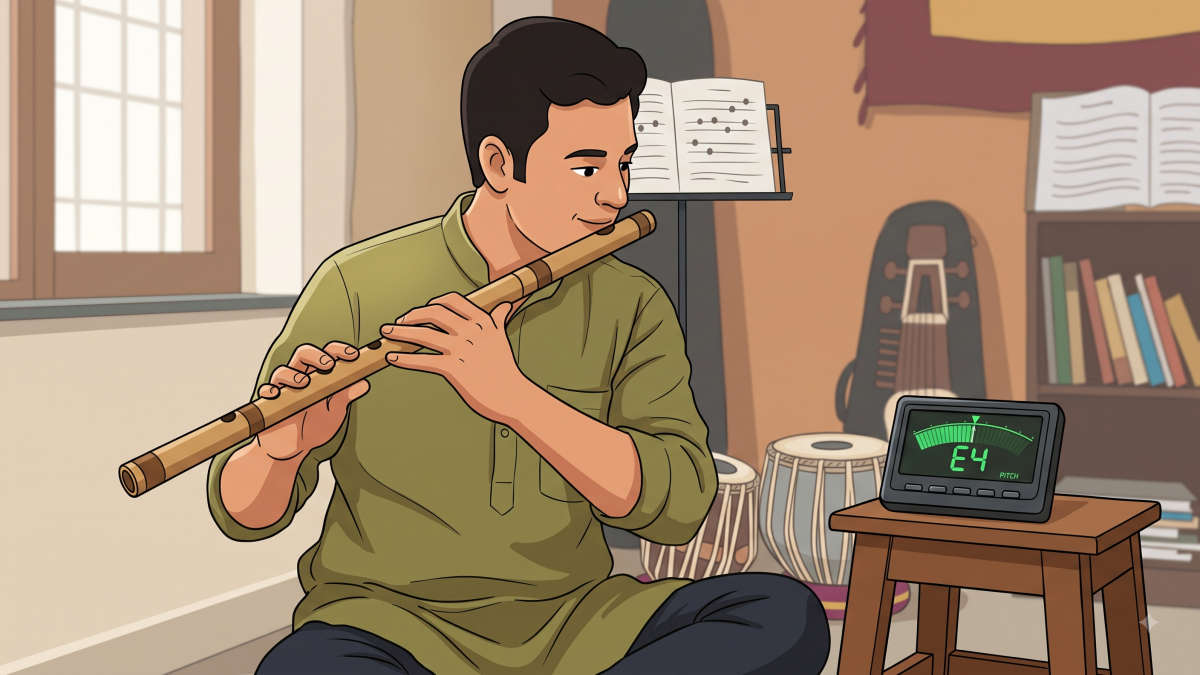
Now pick up your flute and locate the note you were humming. If you suspect the home note is G, play G on your flute and match it to the recording. You can also use the to check your pitch and verify your 440Hz frequency.
Step 4: Check Whether Your Note Truly Feels Stable
Play your candidate note while the song plays in the background. Does it sound harmonious, grounded, and stable underneath the melody? If so, your tonic hypothesis is solid.
Step 5: Determine Whether the Song Is Major or Minor
Once the root is fixed (e.g. D), test whether the 3rd note is Major (Shuddha Ga / F#) or Minor (Komal ga / F).
Step 6: Test Several Notes From the Melody
Take one short melodic phrase. Find 3 to 4 notes on your flute. If most notes fit comfortably into your scale, your theory is confirmed. Don't panic if you hit an accidental (passing note, meend, or chromatic ornamentation)—look at the broader pattern!
Step 7: Listen Carefully to the Ending Phrase
The final cadence of the song or chorus almost always resolves straight into the tonic/Sa. Notice where the music comes to rest before silence.
Step 8: Use the Accompanying Chords When Available
If chord charts exist: G – C – D – Em strongly points to G Major. C – F – G – Am points to C Major. Remember that relative minors (C Major and A Minor) share identical notes, so verify which note acts as home base!
Step 9: Use Sa–Re–Ga–Ma for Indian / Bansuri Music
Once Sa is fixed, you can navigate the whole melody using swaras (S R G M P D N). This unlocks effortless transposition on bansuri for film melodies, bhajans, ghazals, and classical bandishes. Explore our and to master fingerings across Mandra, Madhya, and Taar Saptak.
Western Note Names & Indian Swaras Reference
Bridging 12 Western Chromatic Pitches with 12 Indian Swaras (When Sa = C)
You don't need to choose between Western notation and Indian Swaras. A versatile flute player uses both! Below is the complete relationship chart with interactive audio preview tones for each note.
| Western Note | Full Swara Name | Abbr | Swara Type |
|---|---|---|---|
| C | Shadja | S | Shuddha (Natural / Fixed) |
| C# / Db | Komal Rishabh | r | Komal (Flat) |
| D | Shuddha Rishabh | R | Shuddha (Natural) |
| D# / Eb | Komal Gandhar | g | Komal (Flat) |
| E | Shuddha Gandhar | G | Shuddha (Natural) |
| F | Shuddha Madhyam | M | Shuddha (Natural) |
| F# / Gb | Tivra Madhyam | M^ | Tivra (Sharp) |
| G | Pancham | P | Shuddha (Natural / Fixed) |
| G# / Ab | Komal Dhaivat | d | Komal (Flat) |
| A | Shuddha Dhaivat | D | Shuddha (Natural) |
| A# / Bb | Komal Nishad | n | Komal (Flat) |
| B | Shuddha Nishad | N | Shuddha (Natural) |
🔑 Sa is a Relational Reference, NOT a Permanently Fixed Pitch:
Unlike Western fixed pitches (where C is always 261.6 Hz), in Indian music Sa can be established at any pitch (G, D, E, etc.) depending on the singer or your bansuri scale. To easily convert swaras to Western notes for any scale, try our .
Song Key vs. Flute Pitch
Why you don't always need a flute matching the song's key
Another widespread misunderstanding is assuming: "If a song is in G, I must have a G flute."
Not necessarily! The key of a recording and the flute you select to play the melody are two distinct choices. A flutist can easily transpose melodies to suit their flute's comfort zone.
A Practical Walkthrough Example
Real-life detective work to pinpoint a song's key
Imagine you hear an unknown film or devotional track and want to determine its scale:
- Listen: You notice the music feels grounded and resolved around the pitch G.
- Hum: You hum that steady pitch.
- Match on Flute: You blow G on your bansuri—it blends smoothly with the audio.
- Test Scale: You play
G – A – B – C – D – E – F# – G. Every melodic line fits effortlessly. - Confirm Harmony: You notice underlying guitar/tanpura chords: G, C, D, and Em.
Notice: You did not rely on just one single note—you synthesized Tonal center + melody + scale + harmony + resolution.
Pro Tricks to Train Your Ear
Two rapid techniques for finding the scale without sheet music
Trick 1: The "Sudden Pause" Technique
Play the song. At the end of any musical phrase, hit pause abruptly. Then ask yourself: "What note does my brain crave to hear next?" Play that note on your flute. If it produces immediate relief and completion, you have found the tonic!
Trick 2: The Continuous Drone Method
Play a continuous drone pitch on your flute or Tanpura app while the track is running. Does the melody orbit organically around it? If the track feels harmonically anchored and resonant without discordance, you've confirmed your tonic Sa!
8 Common Mistakes & How to Fix Them
Pitfalls to avoid when identifying song scales on flute
Quick Reference Cheat Sheet
What you hear vs. What to investigate
| What You Hear in the Song | What to Investigate on Flute |
|---|---|
| The song feels settled on one note | Possible tonic / Sa candidate |
| The melody starts on another note | Don’t assume it is tonic; check resolution |
| Major third (Shuddha Ga) fits the melody | Possible Major / Bilawal / Kalyan tonality |
| Minor third (Komal ga) fits the melody | Possible Minor / Kafi / Asavari tonality |
| Several melody notes fit one scale | Stronger confirmation of key |
| Important phrases resolve to one note | Strong tonic clue |
| Chords repeatedly return to one harmony | Possible tonal center |
| Song suddenly feels centered elsewhere | Possible Key Change (Modulation) |
| Notes do not fit simple Major/Minor | Consider Modal, chromatic, or Raga framework |
| Key detector gives a result | Verify it with your ear and flute |
The Universal Flute Scale Formula
Find the home note (Sa / Tonic)
↓ Match it on your flute
↓ Test the scale around it (Major vs Minor)
↓ Play several melody notes
↓ Check phrase endings and final resolution
↓ Confirm with chords or drone
↓ Map to your favorite flute!
Frequently Asked Questions
Common questions about finding song keys on bansuri
Related Flute Learning Guides & Tools
Continue building your ear, fingering agility, and raga repertoire

About the Author
Written and practice-tested by Aplut, a self-taught bansuri learner practising since 2022. Content is built on direct practice experience and careful research into classical traditions. Because musical lineages and fingering conventions vary, suggestions and corrections are always welcomed via our contact page or at [email protected]. First-hand instrument experience is identified clearly whenever gear is reviewed.